The Shortest History of Europe by Hirst John
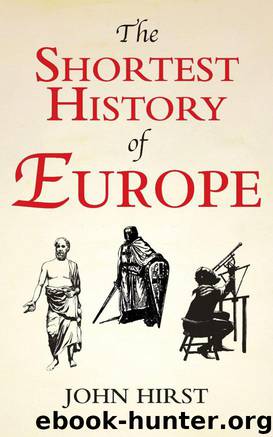
Author:Hirst, John [Hirst, John]
Language: eng
Format: epub, mobi, azw3
ISBN: 9781906964696
Publisher: Old Street Publishing
Published: 2011-02-08T21:00:00+00:00
Jacques-Louis David, The Oath of the Horatii, 1784.
It was a ferocious, terrifying battle, a battle to the death, wonderfully described by Livy. Only one man survives, one of the sons of Horatius, so Rome has won. The victor comes home and finds his sister crying because her fiancé is dead, killed by her brother. The brother takes out his sword and runs it through his sister; kills her, for weeping when she should have been rejoicing at his own and Rome’s success. Again the message is that family has to be sacrificed in the service of the state. The brother is put on trial but is quickly found to be not guilty. The father turns up at the trial, criticises his daughter, and so helps to free his son.
* * *
THE ROMAN REPUBLIC LASTED for a couple of hundred years and then it began to fall into disorder. Rome had expanded; its great generals who had made its conquests became rivals and began to fight each other. Their soldiers were loyal to them rather than to the republic. One great general emerged and conquered all the others: Julius Caesar. The second Brutus organised the assassination of Caesar to save the republic from one-man rule, but that deed simply led to another round of civil wars between Brutus and his fellow conspirators on one side and the friends of Caesar on the other. One man emerged victorious: Caesar’s great-nephew and adopted son, who in 27 BC made himself into Rome’s first emperor under the name Augustus.
Augustus was very astute. He kept the republican institutions; the assemblies still met and consuls were still elected. He called himself not ‘emperor’ but ‘first citizen’. He saw his job as a sort of facilitator, or he pretended he was a facilitator, just helping the machinery to work properly. There was no great pomp; he did not have a great escort; he walked around Rome like an ordinary citizen without a bodyguard; he went into the Senate, which was still meeting, and listened to the debates; he was personally very accessible. The form of greeting and the way you showed your allegiance remained the raised-arm salute. When you came into Augustus’s presence you did not have to bow or show any deference; you and the emperor saluted each other.
Download
The Shortest History of Europe by Hirst John.mobi
The Shortest History of Europe by Hirst John.azw3
This site does not store any files on its server. We only index and link to content provided by other sites. Please contact the content providers to delete copyright contents if any and email us, we'll remove relevant links or contents immediately.
| Africa | Americas |
| Arctic & Antarctica | Asia |
| Australia & Oceania | Europe |
| Middle East | Russia |
| United States | World |
| Ancient Civilizations | Military |
| Historical Study & Educational Resources |
Room 212 by Kate Stewart(5185)
The Crown by Robert Lacey(4866)
Endurance: Shackleton's Incredible Voyage by Alfred Lansing(4847)
The Iron Duke by The Iron Duke(4408)
The Rape of Nanking by Iris Chang(4265)
Joan of Arc by Mary Gordon(4158)
Say Nothing by Patrick Radden Keefe(4048)
Killing England by Bill O'Reilly(4043)
I'll Give You the Sun by Jandy Nelson(3498)
Shadow of Night by Deborah Harkness(3412)
Hitler's Monsters by Eric Kurlander(3387)
Blood and Sand by Alex Von Tunzelmann(3242)
Mary, Queen of Scots, and the Murder of Lord Darnley by Alison Weir(3241)
Eleanor & Park by Rainbow Rowell(3239)
Darkest Hour by Anthony McCarten(3162)
Margaret Thatcher: The Autobiography by Thatcher Margaret(3113)
Book of Life by Deborah Harkness(2986)
Red Famine: Stalin's War on Ukraine by Anne Applebaum(2972)
The One Memory of Flora Banks by Emily Barr(2900)
